
In the twentieth century, glass was commonly chosen as the primary material for transparent needs. It felt permanent, it looked right, and decades of construction practice backed it up. But the building industry has been quietly revising that assumption and the shift is now visible in airport terminals, metro stations and greenhouse installations across India and beyond.
This is not a case of polycarbonate replacing glass aside. Both materials have genuine strengths. But according to old reflex: glass for quality and polycarbonate for budget no longer reflects what these materials actually deliver on site.
The Core Comparison: Where It Actually Matters
Start with weight. A standard 6mm glass panel weighs around 15 kg per square metre. A polycarbonate sheet of same thickness just weighs 7.2 kg per square metre.That gap widens with thickness. For any project where structural load or ease of handling is a factor, it shapes what is structural and affordable.
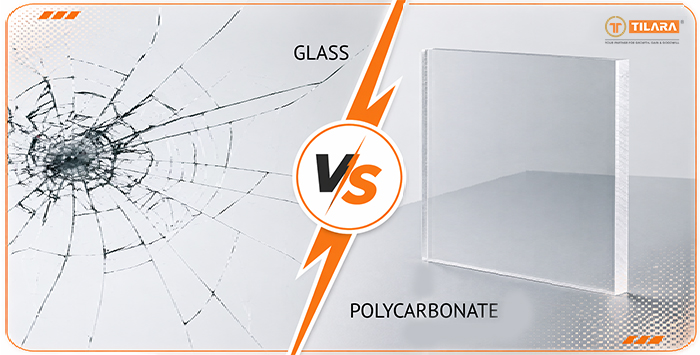
Then there is impact resistance. Polycarbonate gives 250 times better result as compared to a glass of equal thicknesses. Even if a polycarbonate panel gets a strike from a falling tool, a hailstorm, or an accidental vehicle impact it does not shatter or break. Glass does. In applications where safety or barrier continuity matters covered walkways, skylight installations, transport infrastructure roofing carries real consequences.
Light Transmission: Closer than you would expect
One of the misconceptions about polycarbonate is that it sacrifices optical clarity. Tilara Polyplast’s solid polycarbonate sheets transmit up to 88% of visible light a figure that competes directly with standard float glass. For day lighting applications in industrial buildings, commercial canopies, or transit shelters, polycarbonate delivers the light penetration architects want without the fragility risk glass carries.
Multiwall polycarbonate configurations add insulation to the equation. A twin-wall or multi-layer polycarbonate sheet delivers thermal performance values that single-panel glass simply cannot match, reducing heat gain in summer and heat loss in winter directly affecting energy consumption over the building’s operational life.
UV Protection That's Part of the Material, Not a Coating on Top
Untreated polycarbonate can degrade under prolonged UV exposure-this is a real limitation, and it’s why the standard at quality polycarbonate sheets suppliers is co-extruded UV protection. Tilara Polyplast’s sheets carry a UV-resistant layer applied during manufacture, not added as a surface coating that can weather off over years.
The practical difference: the UV protection holds through the sheet’s lifespan. Optical clarity is maintained. And you don’t have to plan for a recoating cycle midway through a building’s service life.
Design Flexibility: What Glass Can't Do On-Site
Polycarbonate can be cold-bent on-site to curved geometries. To achieve the same curves with glass, you need specialist curved glass fabrication at significant cost and lead time.Polycarbonate opens designs for canopies, curved facades, and barrel-vault skylights providing flexibility and affordability that glass cannot match.
Polycarbonate can be cut, drilled, and fastened. For complex multi-panel installations, that reduces skilled labour requirements and project risk in ways that procurement teams particularly those involved in polycarbonate sheet for construction projects have come to factor into their material decisions.
Safety Standards Are Tightening and Polycarbonate Meets Them by Default
For metro station roofing, airport canopies, or school gymnasium skylights where a failure has serious safety consequences that’s a meaningful distinction. It is also why polycarbonate sheet for industrial use increasingly appears in specifications for environments where durability and personnel safety are non-negotiable.
Where Glass Still Makes Sense
The honest version of this comparison includes glass’s real advantages. Scratch resistance is one of them polycarbonate surfaces need care during cleaning and are more susceptible to abrasion without protective coatings.
The point here isn’t that polycarbonate replaces glass everywhere. The point is that the old assumption: glass is the material, polycarbonate is the budget alternative doesn’t hold across the range of applications modern construction actually demands.
What the Project Record Shows
Tilara Polyplast is a leading polycarbonate solid sheets and multiwall sheets manufacturer that are used in industrial and infrastructure products. Our sheets are made using advanced extrusion lines, consistent thickness tolerances, and precise quality control.
Our Polycarbonate Sheets have been used in major projects. Some of them are Kanpur Metro Station, Lucknow Airport Link Road, and Ratlam Railway Junction.
If you are looking for materials for a noise barrier project and need guidance on panel design or site-specific requirements, our experts are ready to guide you with the right solutions.
Why Sourcing from the Right Manufacturer Matters
Tilara Polyplast is a prominent Polycarbonate Sheet Manufacturer, Supplier and Exporter in India. Our wide range of products include solid polycarbonate sheets, multiwall polycarbonate sheets, and profiled polycarbonate.
Not all polycarbonate sheet is manufactured to the same standard, and the variance matters more than it might seem. UV protection quality, consistent sheet thickness, impact performance at temperature extremes these properties depend on how the material is manufactured, not just what grade it’s labelled.