
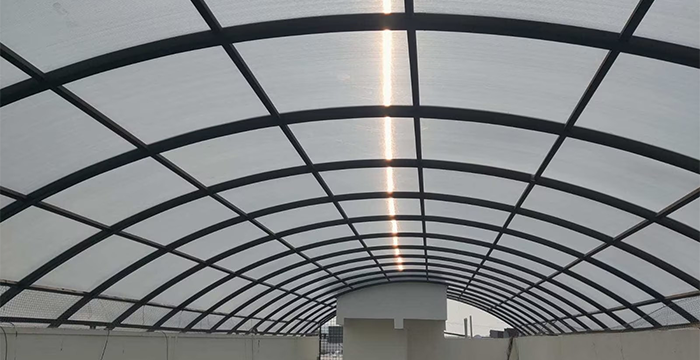
Most roofing decisions come down to two questions: will it hold up, and what will it cost to run the building underneath it. A Transparent Polycarbonate Roofing Sheet answers both better than people expect. It lets daylight into spaces that would otherwise need the lights on from morning to evening, and it does that without giving up the toughness you’d want from any outdoor roofing material.
This is where Har Roof Tilara comes in not simply as a roofing campaign, but as an effort to help people understand what actually matters when choosing a roofing sheet. From light transmission and UV protection to durability and installation, the right roofing material can influence how a building performs over the years.
This is not a new concept; greenhouses have been using such light-permeable materials for many years. The difference is that the same concept is now being used in other areas like warehouses, factories, car parks, and roofed passages because the cost of lighting during daytime is rising fast.
A Durable Alternative to Conventional Roofing
Energy savings are only half the sustainability story. A roof that needs replacing every few years generates waste and cost regardless of how efficient it is while it’s up.
The material is strong in terms of impact resistance, even when compared to glass and old acrylic sheets, since it does not break like those do. This quality makes polycarbonate suitable for use in industries where hails and other kinds of falling materials are common, and the roofs made out of this material will last for a very long time.
Keeping Spaces Bright Without Sacrificing Protection
The obvious worry with any transparent roof is whether it actually protects anything. Modern polycarbonate sheets are built for outdoor exposure, not just daylight indoors, they’re expected to handle rain, wind, and years of sun without degrading.
The aspect that one can easily miss out on but which is crucial is UV protection. Sheets that have been made with an effective UV shield will remain strong and resistant to yellowing for much longer than unshielded sheets. Failure to apply the protective shield will mean that after a few years the sheet begins to yellow.
Supporting Energy-Efficient Buildings
Nobody needs to tear off an entire roof to get the benefit here. Polycarbonate panels can be installed as sections within an existing roofing layout, such as strips over a work floor, a skylight band along a warehouse aisle, or a canopy over a loading area. Each of these sections can help reduce the building’s dependence on artificial lighting during the day.
Large industrial buildings tend to see the biggest impact simply because they have more square footage that would otherwise sit under electric light for a full shift. Smaller structures still benefit, just at a smaller scale.
Lightweight, Flexible, and Practical
Polycarbonate is comparatively light compared to many conventional roofing materials in two ways. First, because they are lightweight, they are easier to install. Second, they exert a smaller force on the framework, which can be relevant if you are replacing the roof in an existing building that was not designed for the weight of the roof.
That flexibility is part of why the material shows up in so many different settings such as industrial roofing, skylights, canopies, covered walkways, agricultural buildings. It’s less about one perfect application and more about a material that adapts to whatever the project needs.
Why Choose Tilara Polyplast?
It cannot be said that all polycarbonate sheets have been made using the same process. There are vast differences between the various products when it comes to thickness, the quality of UV coating, and the rate at which they transmit light.
Tilara Polyplast is a leading Transparent Polycarbonate Roofing Sheet Manufacturer, offering high-quality sheets designed for long-term performance. These sheets are built to maintain their clarity, strength, and durability over time rather than simply looking good on day one.
FAQs
It is a lightweight roof sheet material constructed using polycarbonate which allows passage of sunlight but is able to withstand outdoor weather conditions.
Yes, at least on the lighting side. Letting daylight into a space during the day cuts down on how much artificial lighting you need to run.
It cuts daytime reliance on artificial lighting, and its durability means the roof doesn’t need replacing as often — both of which reduce the material and energy footprint over time.